
Moog Music Logo

Moog Minimoog Model D Monophonic Analog Synthesizer

Rating average

Photos

Featured Video

Description

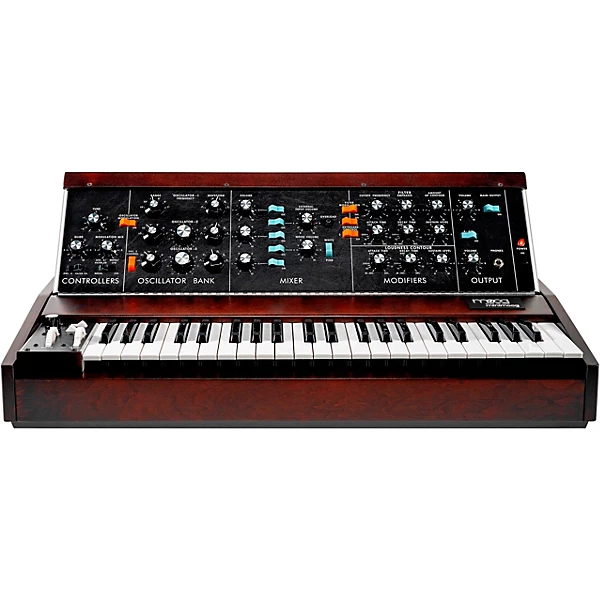
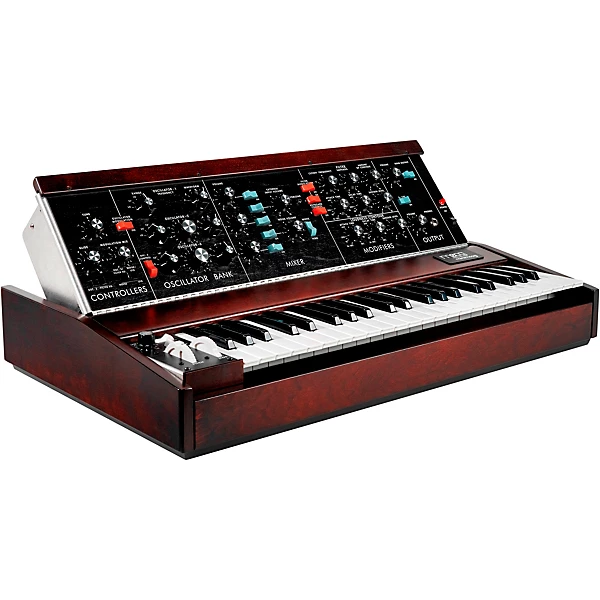
The Moog Minimoog Model D is an analog monophonic synthesizer that shaped the future of electronic music. This reissue of the 1970s classic lets you craft sounds that defined pop culture. With its handcrafted analog circuitry, the Model D generates a warmth and depth unmatched by digital synthesizers. Whether you’re a producer searching for that elusive vintage tone or a performer ready to unleash snarling leads and throbbing bass, the Model D delivers.

Handcrafted Analog Circuitry Provides Iconic Tone

At the heart of the Model D lies its handcrafted analog circuitry, built to the exacting specifications of the original. This all-analog signal path gives the Model D a richness, depth and character that digital synths can’t replicate. Sculpt sounds from subtle to outrageous using its voltage-controlled oscillators, low-pass ladder filter and envelope generators. From warm pads to aggressive blips and blurps, the Model D’s analog guts impart a retro-futuristic tone that’s all its own.

Perform and Sequence With Onboard Controls

Unlike software synths that hide parameters behind menus, the Model D puts all controls front and center. Its thoughtfully laid out panel features over 20 knobs and switches, giving you intuitive, hands-on control of each parameter. Craft sounds on the fly or sequence automated filter sweeps, oscillator syncs and envelope modulations. With MIDI connectivity, you can also control the Model D’s analog heart from your DAW or hardware sequencer.

Reimagined Enclosure Built to Tour

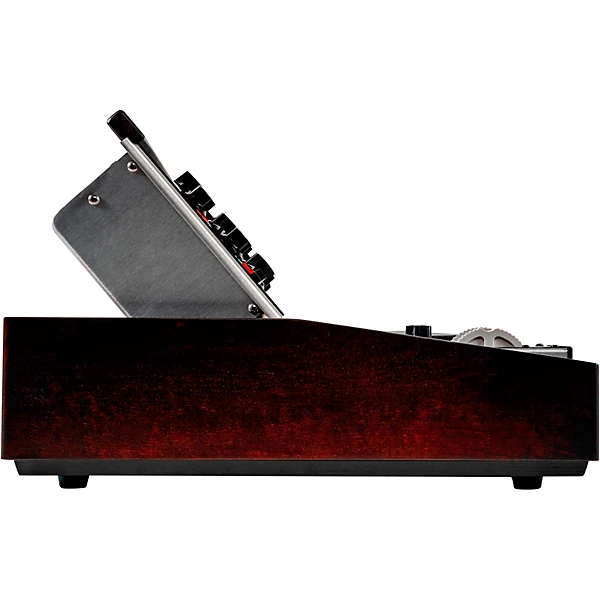
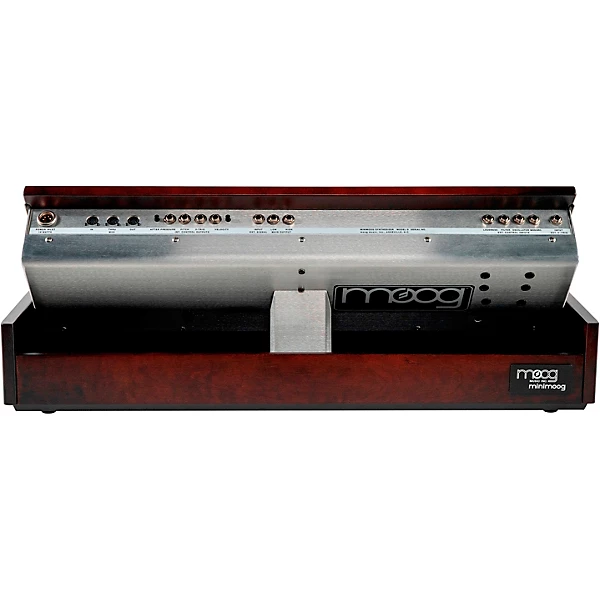
While the Minimoog Model D’s sound remains largely unchanged, Moog redesigned its enclosure for life on the road. A durable steel chassis and aluminum side panels shield the analog circuitry from interference, allowing the Model D to share a stage with digital gear. Rear panel connections include int. control outs, MIDI in/out/thru, ext. signal inputs and ext. controller inputs. Weighing 32-pounds the Model D can fit into a ATA road case for transport between the studio and stage.

Craft Your Own Legend

For over four decades, artists like Gary Numan, Depeche Mode and Nine Inch Nails relied on the Minimoog Model D to forge new musical frontiers. Now you can tap into this legendary instrument and craft your own iconic sounds.


Specifications

Keyboard

  • Number of keys: 44
  • Keyboard range: F0 to C4
  • Keyboard action: Synthesizer (spring)
  • Note priority: Low, high, last; user selectable

Oscillator

  • Sound sources: 3 oscillators, noise generator and external audio input
  • Oscillator frequency range: 0.1 to 20kHz (in six overlapping ranges)
  • Oscillator stability (short term): > 0.25 %
  • Oscillator waveforms: Triangle, Triangle-Sawtooth (Oscillator–1, Oscillator–2), Reverse Sawtooth (Oscillator–3), Sawtooth, Rectangle, Wide Pulse and Narrow Pulse
  • Noise generator: White and pink
  • LFO rate: 0.05Hz to 200Hz
  • LFO waveform: Triangle (knob down); Square (knob up)

External Modulation Input

  • Range: +10 millivolts to +2 volts
  • Impedance: 1 megaohm

Filter

  • Type: Voltage-controlled low pass (Ladder Filter)
  • Frequency range: 10Hz to 20kHz
  • Slope: 24dB per octave
  • Keyboard tracking: 1/3, 2/3, 1:1

Contour

  • Attack time: 1 millisecond to 10 seconds
  • Decay time: 4 milliseconds to > 35 seconds
  • Sustain level: 0 to 100% of contour peak
  • Filter contour width: 0 to 4 octaves

External Audio Input

  • Voltage: +10 millivolts (min); +10 volt (max.)
  • Nominal impedance: 1,000 kohms

Voltage-Controlled Amplifier

  • Loudness contour dynamic range: 80dB

High Audio Output

  • Typical voltage: 0.5 volts/maximum voltage: 4.2 volts (peak to peak)
  • Nominal impedance: 3 kohms

Low Audio Output (30dB Below High Level)

  • Typical voltage: 15 millivolts
  • Nominal impedance: 1 kohms

Headphone Output

  • Voltage: Maximum 0.3 volts
  • Impedance: 8 ohms

Other

  • Glide rate: 1 millisecond to 10 seconds
  • Pitch bend rate: (+/–) 7 semitones (minimum)
  • After pressure CV output (1/4″ TS): 0 to +5 volts with user adjustable trimpot
  • Pitch CV output (1/4 ” TS): –3 volts to +7 volts (C=0 volts)
  • Gate output (1/4″ TS): 0 to +5 volts
  • Velocity Output (1/4″ TS): Selectable 0 to +5 volts or 0 to +10 volts with user adjustable trimpot.
  • LOUDNESS INPUT (1/4″ TS): 0 to +5 volts; +5 volts = Unity Gain (Works with Moog EP-3 Expression Pedal)
  • Filter cutoff input (1/4″ TS): 1 volt per octave of change (works with Moog EP-3 Expression Pedal)
  • Oscillator pitch input (1/4″ TRS): 1 volt per octave of change (works with Moog EP-3 Expression Pedal)
  • Modulation source input (1/4″ TRS): Ring = noise send; tip = modulation receive (this jack makes a normalled connection with no cable present)
  • Trigger input (1/4″ TS): +5-volt V-Trigger activates both contour generators
  • MIDI input (5-pin DIN): Note On & Note #
  • MIDI output (5-pin DIN): Note on, note #; velocity; aftertouch, mod wheel, pitch bend
  • MIDI thru (5-pin DIN): Mirror of the MIDI In signal
  • External power supply: Self-switching; 100–240 volts; 50/60Hz; < 12-watt nominal consumption (locking XLR-4 connector)

Dimensions and Weight

  • Dimensions, with panel lowered (WxDxH): 28.625″ x 17.125″ x 5.75″
  • Weight: 32 lb.