
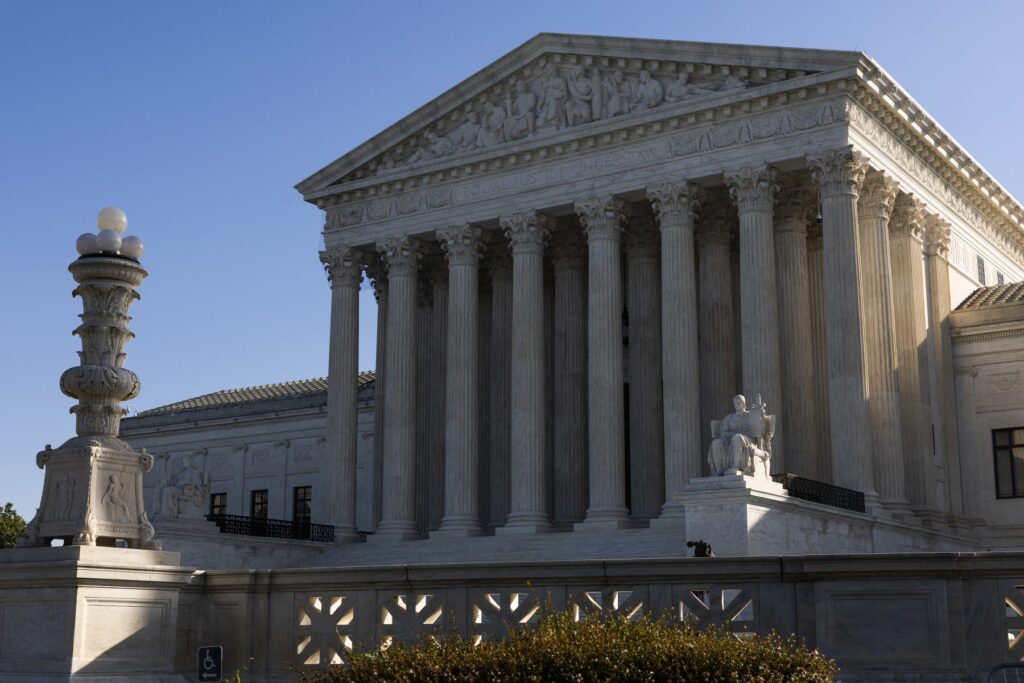
The U.S. Supreme Court will not disturb a ruling that lets songwriters who use copyright termination take back their songs worldwide, not only in the United States. In an order issued Monday (Oct. 19), the court affirmed the Fifth Circuit’s January decision in favor of Cyril Vetter, co-writer of the 1960s rock ‘n’ roll hit “Double Shot (Of My Baby’s Love),” leaving the publishing arms of Universal Music Group, Sony Music, Warner Music Group and BMG on the losing end.
An unusual way to end a case
The result came through a rarely used procedure. Justices Sonia Sotomayor, Neil Gorsuch, Amy Coney Barrett and Ketanji Brown Jackson took no part in the petition, which left the court without a quorum. Because the remaining justices concluded the case could not be heard and decided in the next term, federal law directed the court to affirm the lower-court judgment, with the same effect as a split-vote affirmance. The order gave no reason for the recusals; Bloomberg Law noted that BMG’s parent company, Bertelsmann, also owns Penguin Random House, which has published books by those justices.
As Billboard and Bloomberg Law point out, the outcome does not make the Fifth Circuit’s view the law of the land. The Second and Ninth Circuits, covering New York and California, have taken the opposite position on foreign rights, so the question could return to the high court later.
What is at stake
U.S. law lets creators cancel old copyright transfers after decades (pre-1978 grants qualify after 56 years) so they can share in the value of work they signed away early. For years the industry assumed that recapture stopped at the U.S. border, with publishers keeping overseas rights. Vetter, who wrote the song with the late Donald Smith in 1962 and assigned it to Windsong Music Publishers a year later, served his termination notice in 2019, effective 2022. A Louisiana federal judge declared him the worldwide owner in 2025, and the Fifth Circuit agreed.
The four music companies bought Resnik Music Group’s interest in the song after that ruling and asked the justices to step in, arguing the decision “unsettled 50 years of industry practice.” Vetter’s lawyers called those fears overblown.
Featured image: The U.S. Supreme Court Building in Washington, D.C. Photo: Finn Gomez/Getty Images, via Billboard.